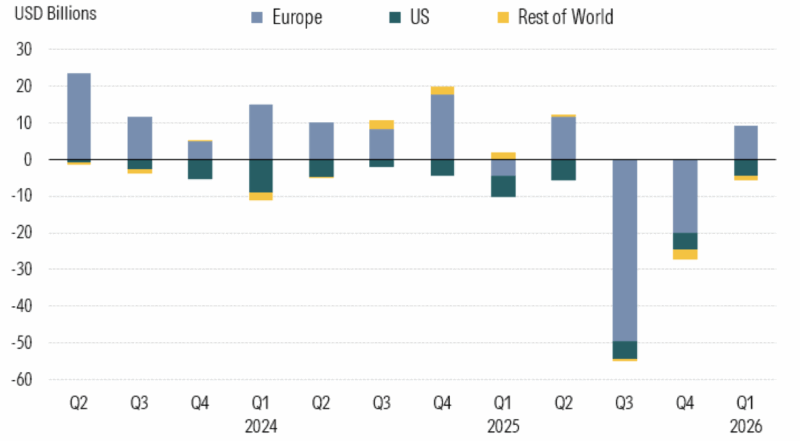





Global sustainable funds have returned to net inflows at $3.5bn in the first quarter of 2026, a sharp reversal from $27bn in outflows in Q4 2025, according to new flows data from Morningstar.
However, the data shows a sharp regional divergence amid ongoing pressure from market and political headwinds.
The report found the rebound was primarily driven by Europe, where flows reversed sharply, attracting $9.1bn in inflows. This is the first positive quarter for the region since Q3 2024.
However, US sustainable funds recorded their 14th consecutive quarter of outflows at $4.3bn. The rest of the world in aggregate also recorded net outflows, apart from Canada and Australia/New Zealand, which saw modest inflows of $400m and $300m, respectively.
The report also found that global sustainable funds assets declined by around 10% in Q1 to a total of $3.51trn due to market volatility concerns.
See also: Sustainable fund outflows slow in Q4
Just 17 new sustainable funds launched globally in the first quarter, down from 50 in the previous quarter. The largest share of new launches came from Asia ex Japan, where nine new sustainable funds were incepted, while Europe contributed eight, Morningstar said.
The US launched no new sustainable funds. Meanwhile, 13 sustainable funds were closed in Q1 with five coming from Invesco.
“The return to modest inflows in the first quarter suggests that investor appetite for sustainable strategies has not disappeared, but it remains fragile and highly region-specific. Europe continues to stand out, with flows turning positive again, supported by strong demand for passive strategies,” said Kenneth Lamont, principal, manager research at Morningstar.
“The landscape for sustainable funds is still complex. Market volatility, geopolitical uncertainty, and evolving regulation are all influencing investor behaviour, while asset managers are becoming more cautious in bringing new products to market.
“What we are seeing is a reset rather than a retreat. Growth is continuing, but at a slower pace, with investors becoming more selective and more focused on clarity around strategy, outcomes, and value.”